Peter Vack on Memes, Filmmaking and the Long Road to Rachel Ormont
An actor, writer, director—and meme administrator—Peter Vack has spent the last decade moving fluidly between cult television, indie cinema, and literature, with a particular fixation on internet life. His second feature, www.RachelOrmont.com, has become one of Roxy Cinema’s most popular and longest-running screenings—a midnight-movie fixture whose audiences continue to grow with each return engagement.
A dystopian techno-satire of digital life, performance, and parasocial desire, www.RachelOrmont.com has earned its reputation as a modern cult classic: unsettling, funny, and uncannily precise in its portrayal of the psychic conditions of being online. The film’s staying power at the Roxy reflects not only its provocation, but also the loyalty of a viewership that recognizes itself—sometimes uncomfortably—on screen.
We spoke with Vack about the long road to making www.RachelOrmont.com, his evolution from actor to filmmaker to novelist, and the strange rewards of building work that refuses to compromise.
Hillary Sproul: Tell me how Rachel Ormont came about.
Peter Vack: Well, it took a long time to write. I was reading about the internet in 2013 and felt that the internet was underrepresented in cinema. And it was—it’s been more represented now—but I was kind of possessed by this idea that movies had to include the internet as a character because that was where we were increasingly living. I didn’t see it enough, and it felt like a big issue.
I wasn’t really very online at all at the time. That came later. And my becoming very online really did influence the script. Initially, I was reading Jaron Lanier, Jonathan Crary… and the script almost felt like a book report. My approach was very academic. I rewrote the script dozens of times—like 60 or 75 times. But really more than that, because even on set I’m always adding material and changing things. The writing process was just very long.
Then I made Assholes. And I wrote my novel, Sillyboy. The script was very much in a drawer. I really lost connection with it. And then I became a sort of chronically online meme admin.
So how did you go from not very online to a chronically online meme admin?
PV: I was a little late to Instagram. I think I made my account in 2015 and felt like I was a year or two late. I got into it through shitposting. I started following cursed image pages. I thought Instagram was like Tumblr. I didn’t know it was about posting selfies. I thought it was an antidote to Facebook, which had become about advertising yourself.
I was always doing performance-art–style posting from the very beginning. I wasn’t interested in memes because they weren’t funny. Then I saw my first niche meme. It was a picture of Nicole Richie. The text was something like, “When you’re lurking Soho House for the middle-aged man who’s going to finance your post-collegiate mumblecore feature.” And I was like, whoa, that’s funny. I’d never seen a niche meme before.
I was a fan of post-internet art, but I was always an outsider to it. Those artists were coders—they knew Photoshop. I knew I wasn’t going to acquire those skills. But memes are image macros. You either find them or they exist, and the creativity is in the text. And I thought that was something I could do.
Do you remember how you started actually making them?
PV: I met the creator of that meme through an internet friendship. I was shooting The Bold Type in Montreal, where she lived, and I remember one night saying, “Will you please just teach me how to make memes?” It was the most rudimentary style—you literally screenshot something from Twitter. Eventually I found PicsArt, which I still use to this day.
Once I knew how to make a meme, I was posting one to five memes a day. I’ve basically been doing that since 2018.
There’s very little instant payoff in the world of film and acting—or even writing. With memes, it must have been satisfying to get a response right away.
PV: Exactly. And it’s also why they’re so addictive, because the feedback is so immediate. You can spend ten years making a movie, you can spend ten years writing a book, and then it’s like, “Oh, we still gotta get people into the fucking theater. I gotta somehow get people to buy this fucking book.”
The amazing thing about making a meme is you’re shooting it right into the vein. Everyone’s on their phone, so they’re seeing that shit. That idea gave a lot of energy to my memeing, my meme administration. And over the years I’ve made so many great friendships through memes. It’s a great way to meet like-minded people, and a lot of really cool communities have developed around memeing and posting.
So Rachel Ormont still wasn’t real, but I was no longer just an outsider looking in—I was an insider. In 2021, I rewrote the script again. It was a major rewrite with my internet-native voice, which now feels to some viewers like the most present thing about the movie. There are many ways to watch a movie, obviously, but I really notice the way people react when they’re chronically online — and I really notice when they’re not.
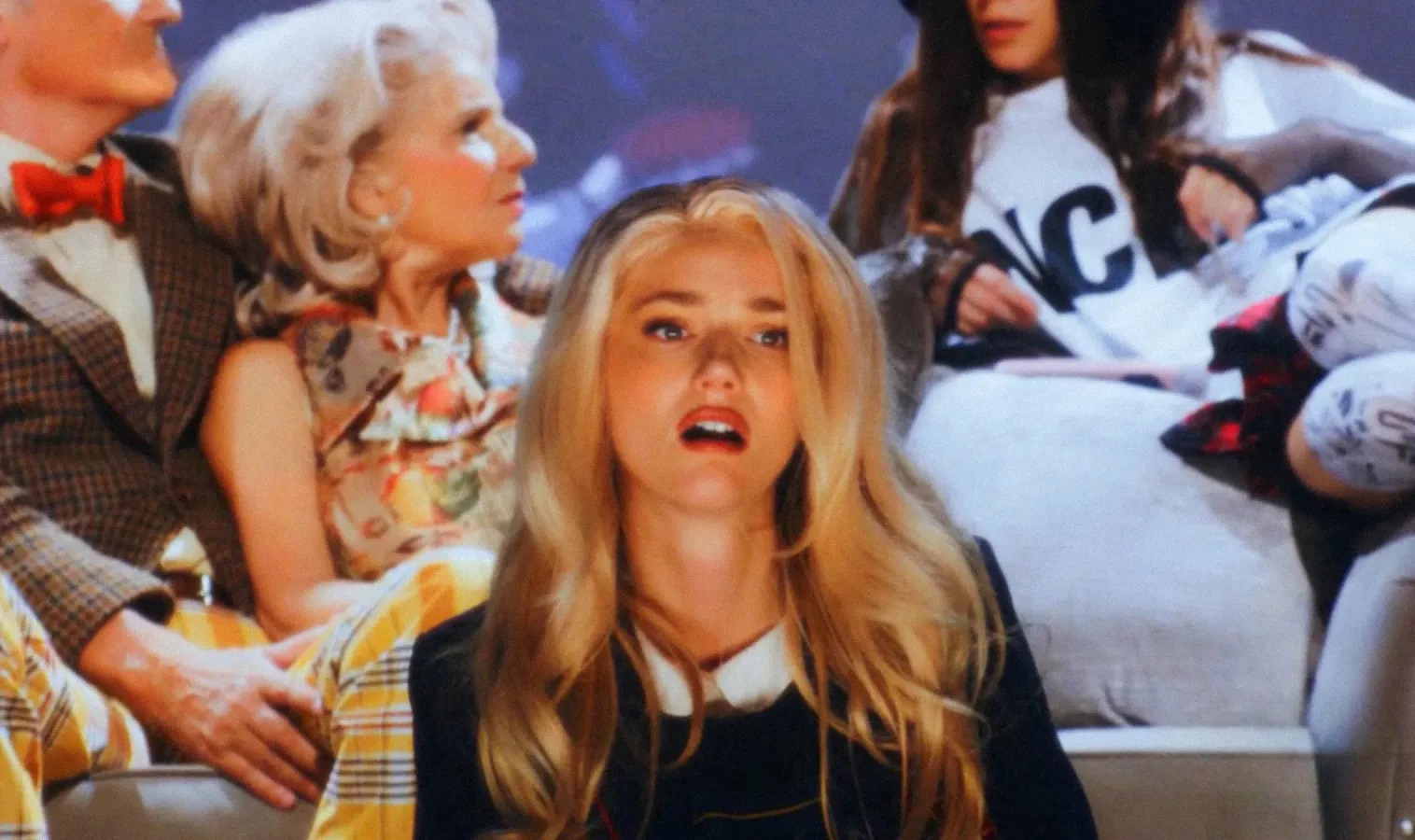
The threat of the Dimes Square scene and the destabilization of self in www.RachelOrmont.com
Do you feel like people who are chronically online like it less?
PV: I think they understand it the most—and they like it less. That’s a generalization, but I’d say the majority of haters are very online. I think it’s too close to home. I think they feel like they’re seeing their own dirty laundry.
People who are offline see it as sci-fi. They experience the language the way you’d experience the Anthony Burgess dialogue in A Clockwork Orange—a baroque way of speaking. Even if they don’t get the references, many people have stumbled upon a corner of the internet where suddenly people are speaking a language that feels foreign to them. That journey feels clear.
Did you always know Betsey was going to play Rachel?
PV: No. I wrote it for Julia Garner. At one point she was attached. But by the time we made the movie, I had begun writing it with Betsey in mind. Julia doesn’t do small movies anymore.
I told Betsey I didn’t think Rachel had her voice—I thought she had a different voice. The voice Betsey used came from how she talked to her dog. It felt like a self-soothing voice. She came to set with that, and it was perfect. I didn’t change it at all.
What was the rehearsal process like?
PV: I don’t rehearse. I would never rehearse a movie—never. But I routinely do more than 30, 40, 50, 60 takes. Cinema wants to see something happen for the first time. So that, in and of itself, becomes a rehearsal process.
And when I have rehearsed as an actor for cinema, I sometimes feel like we get this totally fresh thing in rehearsal that we don’t then get on set. The camera lives for that discovery. But then it’s misleading, because I end up doing a rehearsal-process amount of takes on set.
This was the first film you made that you didn’t act in.
PV: I’m really glad I wasn’t in it. There was no role for me. If there had been a role for me, I would have played it.
Did fully concentrating on directing bring you any kind of relief?
PV: I loved directing. Directing a movie is just a dream come true. But it’s also kind of a nightmare. It’s both. I loved it. But I also loved the experience of acting in Assholes, too. I’m not in that many scenes, but I just loved it. With that project, I would become the tone of the scene that I wanted, and everyone would match that. That was almost more fun.
With Rachel, that was my mode of directing. I embody the tone I want the actor to be in because I don’t believe acting is an intellectual pursuit. It’s very hard to intellectually convey what you want. And look—you have to do this with actors you trust, and who trust you. But you can become the energy, and they’ll get it through osmosis.
When you’re acting in the scene, that becomes very easy. It’s not even an unconventional technique. You are the tone, and everyone becomes the tone because you’re acting in the scene with them. But I do that even when I’m not acting.
Tell me about Sillyboy.
PV: It’s actually about a very self-serious boy. The book isn’t really that silly. It’s about a struggling screenwriter and his younger tattoo-artist girlfriend, and how their relationship stagnates and then unravels—mainly because of parasocial paranoia around Instagram. When I started writing it, that also felt very new.
I started writing it ten years ago, and a lot happened in between. Probably because I’m an actor and do so many other things, my creative projects seem to take forever. After I made Assholes, I picked the book back up. In between, I did tons of film work as an actor, but the book was my focus as a writer from 2017 to 2021. I worked on it and nothing else for about four or five years.
How was the process of writing a book compared to writing a screenplay for you?
PV: Writing is a huge challenge, but I’m a great fan of the novel and always wanted to try my hand at writing one. I thought it might be easier—or at least refreshing—because once it was done, you didn’t then have to raise money to produce it. But it was challenging in other ways.
It’s infinitely rewritable. When you shoot a film, if you have unlimited money, you can do unlimited reshoots. But I’ve never had unlimited money or unlimited reshoots. So there’s a beautiful constraint to the material you have as a filmmaker.
With a novel, you could theoretically rewrite every scene until you’re dead. They could suddenly go to Mars. You can do whatever you want. And a great sentence is as hard to write as it is to shoot a great scene. You have to have so many great sentences in a row, or you could lose your reader at any moment. You can’t hide behind anything. But when it’s done, it’s done—and that’s beautiful.
A screenplay isn’t a literary document; it’s a plan. It’s an instruction manual for a film. So in a way, it’s less rewarding to write. But when you do find your way into a great sentence or paragraph in a novel, you know you did that. I treat my scripts with a lot of reverence while I’m writing them—and a tremendous amount of irreverence when I’m shooting—because the script is not the product.
What’s your favorite New York film?
PV: I can’t tell you. But the director is great at jazz clarinet.
To see the full conversation unfold, watch the video interview—here.
www.RachelOrmont.com is showing at Roxy Cinema on Sunday, March 22, 8:45pm. Tickets available to purchase—here.
WORDS Hillary Sproul
PHOTOGRAPHY Maya Spangler