Lisa Rosen: From the Mudd Club to Chanel to Restoring Great Art
Mudd Club founder Steve Mass reunites with one of the club’s early regulars to talk about downtown nights, an unexpected modeling career and the childhood fascination that led to her life’s work restoring old masterpieces.
I am sitting down with Lisa Rosen in the dining room of the Roxy Hotel. It’s a wonderful sort of reunion, since she was one of the early creatives to populate the Mudd Club. I was particularly interested in how she, as a 17-year-old, navigated such an institution as the Mudd Club and was able to feel perfectly safe and totally at ease as she integrated herself into that scene.
Lisa grew up on the Upper West Side, which in 1978 was dangerous enough without venturing downtown into the environs of the Mudd Club, situated in industrial Chinatown (now Tribeca), an era of virulent Asian and Italian gang culture. How did she have the street knowledge to keep herself in one piece getting around back and forth between the West 80s and this derelict neighborhood without her parents’ knowledge?
Evidently her mother looked the other way, viewing Lisa’s late-night adventures as an opportunity to meet people who could further her career, although she didn’t yet have one. Strange, I thought at the time, and so different from my youth in Macon, Georgia, in the 1950s, where the teenage girls I knew had limited choices about dating, and even about what clothes they could wear, much less going to a nightclub until 3 am without their mother’s knowledge. Those Southern azalea queens from “proper families” would have been told by their United Daughters of the Confederacy (UDC) mothers, “I don’t ask you what you think about what clothes to wear or who to date. I’ll do the thinking for you. You do as you are told.”
Lisa’s mother was not the UDC type and was totally on board when Lisa told her, at the age of 13, that her goal in life was to be an art restorer. It would be like me telling my dad that my goal was to be a motorcycle acrobat and jump over the Grand Canyon. And yet such inventive career trajectories were not unique among the youthful population of the Mudd Club. I remember Rick Bloom, who informed me he wanted to use space satellite technology to beam independent media globally. “Are you crazy?” I said. “That is all controlled by the military.” Yet, a few years later, he became a multimillionaire with that idea. Not to mention Keith Haring, who I hired as a gallerist, having seen him at the Tony Shafrazi Gallery. I had no idea that the artwork he and Jean-Michel were inscribing all over the walls and plywood panels would someday be worth millions.
During our brunch, Lisa talked about Jean-Michel Basquiat in the Mudd days, since she and her brother Danny were his buddies. But wasn’t she interested in becoming one of his paramours? No, she made it clear she wasn’t interested in being a girlfriend. When Basquiat approached her, she talked to him on the arcane level of archival art preservation, lecturing him as though she were already an expert on how to seal wood to prevent moisture from attacking it and lifting the paint off the surface.
At the same time, she loved fashion and helped her friends with the fashion shows taking place at the Mudd Club involving designers still in college, such as Anna Sui. She met the fashion elite at the club and within months found herself modeling Chanel on runways in Paris and Milan.
We went back to talking about her current career as an art restorer in some of Manhattan’s most important public spaces. At one point, I asked her the secret to painting on plywood without the paint lifting off over time. She paused for a few moments, and I was glad when the food arrived. Finally, she said, “Well, I could tell you, but then I’d have to kill you.”
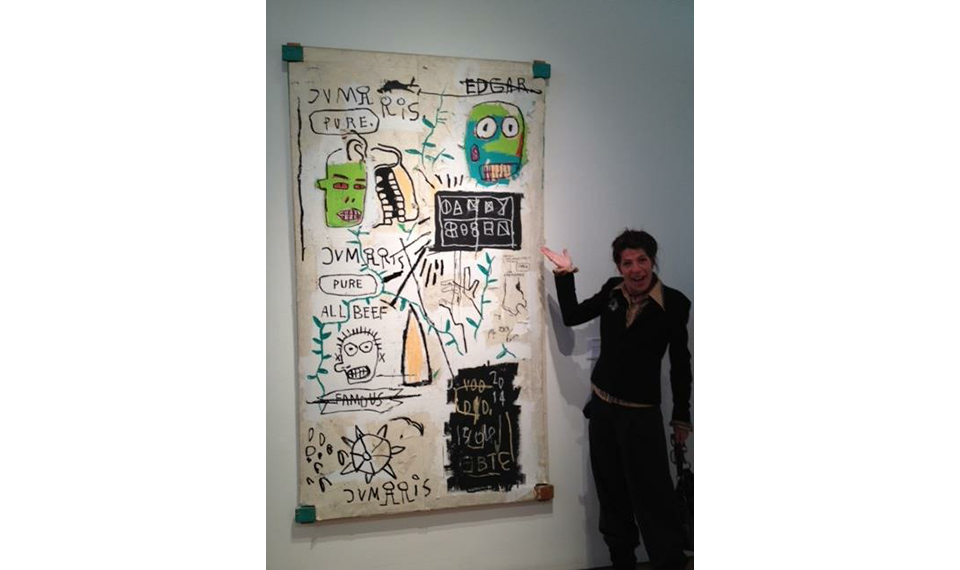
Lisa Rosen with Jean-Michel Basquiat’s portrait of her brother Danny at Christie’s. Courtesy Lisa Rosen.
Steve Mass: Most models who build second careers stay close to fashion or beauty. You went into art restoration. Where did that come from?
Lisa Rosen: I went to LA one summer to visit my best girlfriend, who had moved there. Her sister took us on a tour of the Getty, and she took us into the restoration laboratory. I walked in and I was like, “That’s it. When I grow up….” I was 13 or 14.
I came home and told my mother, and she said, “Write to some museums where we know people, so you’d have somewhere to stay if anyone says yes.” I wrote 20 letters. The only museum that wrote back “yes” was in Copenhagen—the museum the Carlsberg beer company [the Ny Carlsberg Glyptotek] built specifically for antiquities: ancient Rome, ancient Greece, Etruscan pottery. Don’t forget the time—it was a handwritten letter, no photo of me. I think I’d just had my braces taken off. I’m not joking. Forty years later I found the director and wrote to him to say, “Because of you, this has become my life.”
SM: Your mother didn’t push you toward a practical job. Most mothers would have said, you’ve got to get a good job.
LR: My mother is great. She was an art history major at Penn, and it would probably have been her dream to do what I did. Later, when I was working in Rome, she came to visit every year and I had her up on the scaffold. She was thrilled.
SM: And school?
LR: All public schools. I grew up on the Upper West Side and went to Music & Art, which is now LaGuardia, in the art department. I went to the Art Students League children’s class every Saturday.
I remember at Music & Art they said anybody who wanted to take Latin could go over to City College—the campus was right next door—for fourth period. I was the only one in the school that wanted to go, so I would traipse across the campus to this class. And what was interesting was that the other women were all nuns. They were all nuns studying Latin. I was the only one that raised my hand. I was like, “Latin? Are you kidding? Of course I want to learn Latin.”
I got early admission to NYU on a full scholarship, to study the history of the ancient Near East. I was 17. Then I found the Mudd Club.
SM: So what happened to NYU?
LR: I decided I liked the Mudd Club better than waking up early to go to NYU. So my second month at NYU, I stopped going because I couldn’t wake up after being at the Mudd Club till five in the morning, then having breakfast at Dave’s Diner. Going straight to school at 7:30, 8 in the morning? I couldn’t. So I always say I graduated the Mudd Club summa cum laude.
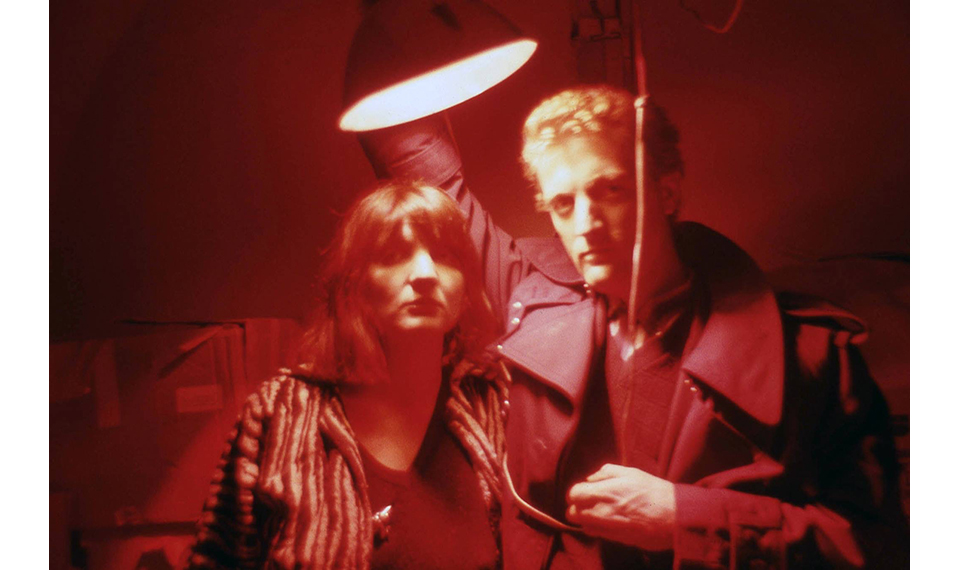
Edit deAk and Walter Robinson in their loft on Wooster Street, 1977. Courtesy Lisa Rosen.
SM: You were part of a circle around Edit deAk. How did that start?
LR: I met Edit in the bathroom at CBGB’s, before the Mudd Club. That night I went and slept over at the loft. We were best friends from that point on. She had this huge loft with Walter [Robinson] originally, when they wrote Art-Rite magazine, and then we younger ones kind of took over. Fab 5 Freddy was there all the time, Johnny Dynell, all of us.
She didn’t do it in a pedagogic way. She wasn’t pretentious or anything. She just introduced us to an art world that we had no idea existed, none of us. At that time it was tiny, based in SoHo, where the fancier galleries were. Alan Vega, Jack Smith. She knew everybody. She was fearless.
There were these older women who were very dear friends of mine, like Edit and Anita Sarko. When you’re 18 or 19 and a 28-year-old gives you the time of day, believe me, you’re going to follow them around like a little puppy. And those amazing outfits Anita would wear. You know how long it must take to get dressed like that? She always looked amazing.
SM: Were you going with Jamie Nares at the time? Did you meet at the Mudd Club?
LR: I was married to James [now Jamie Nares, the artist and filmmaker]. Yeah, we met at the Mudd Club. I remember the first time I saw him across the bar, and I was like, “I’m marrying him.” And I literally did. Our first date was the screening of his film Rome ’78 at that little cinema on 8th Street. David McDermott plays Caligula, and he’s tap dancing with a tooth missing. It’s one of the great scenes. It’s so ingenious because James filmed it at New York monuments that look kind of like Rome. People are wearing togas and walking around, and then you see an airplane flying by.
SM: What do you remember of the nights themselves at the Mudd Club?
LR: Those events were so fantastic. I remember the Joan Crawford night. Oh my God, all those nights. And the night you had real searchlights outside the club, the rays shooting way up into the sky. It blew my mind. Missing a night, I thought I was going to miss something. I never missed a night.
SM: How old were you when you met Jean-Michel?
LR: I met him when I was 18. We were both born in 1960. He and my brother Danny went to City-As-School together. It was the last-chance school, where you’d get credit for playing Frisbee in the park. Danny started going to the Mudd Club at about 16 or 17. He and Eszter Balint were the babies.

Lisa Rosen with Jean-Michel Basquiat after he painted her sweatshirt, photograph by Gerard Pas. Courtesy Lisa Rosen.
SM: Did Jean-Michel ever feel there was no path for him in the art world?
LR: I don’t think he even thought like that. I just think it was that period. It was the Mudd Club ethic: on nothing you create yourself. On nothing. We all dressed with nothing. You went to thrift shops or you found clothes on the street.
I remember seeing John Lurie on Second Avenue and 4th Street, turning the corner to go to his house on 3rd Street, carrying a bag of dry cleaning. I remember stopping James and saying, “He’s made it, he’s made it, he has dry cleaning!” To us, that was the epitome of luxury. Who the fuck has money for dry cleaning?
SM: How did modeling happen?
LR: Patricia Field lent me the money for a one-way ticket to Paris. Before that, Betsey Johnson and Pat Field, when she had the shop on 8th Street, were the only people in New York who used me. I wasn’t really modeling super professionally then. In Paris I stayed in Edwige’s room. She didn’t have an apartment; she rented a room. Edwige was the punk queen of Paris. All you had to say at a club door was, “I’m a friend of Edwige,” and you were in.
We were starving. I remember stealing a can of tuna fish. A week later I was modeling for Chanel. I became a Chanel house girl at 18. And once Chanel takes you on, everybody wants you.
SM: But what were you doing with this dream of becoming an art restorer?
LR: It had receded temporarily. I didn’t know for how long, because I couldn’t predict what was happening. After two months I came home thinking, “That was nice. I did that.” Then Steven Meisel, who was just starting out, said, “Let’s do a shoot for the SoHo Weekly News,” and I got the cover. The editor of Italian Vogue was in New York that week, saw it, tracked me down and booked me for a 10-page editorial in Capri. Instead of flying home from Capri, I changed the ticket to Paris.
From then on I stayed in Europe. Paris, Milan, London. I’d do the runway season and as many editorials as I could, and come back to New York every four months.
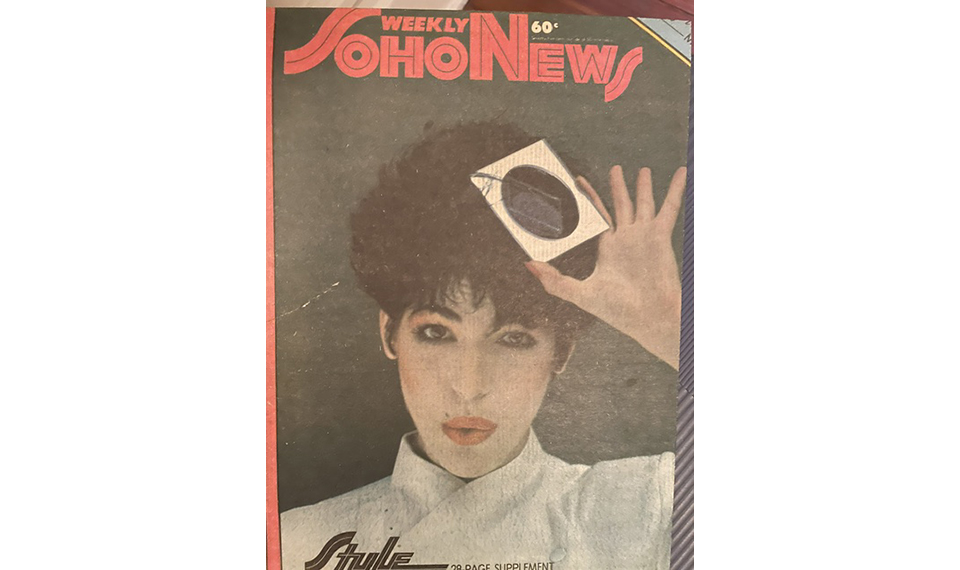
Lisa Rosen on the cover of the SoHo Weekly News style supplement, 1979. Photograph by and courtesy of Steven Meisel.
SM: Who taught you about modeling?
LR: Nobody. I had no idea what I was doing. I didn’t even know what a runway show was. I thought it was like the 1950s, where you held a number and walked.
The first job Chanel flew me to was in Cannes. They sent 12 of us down. I turned around and there were Pat Cleveland, Jerry Hall, all the runway girls I’d been looking at in magazines. I went to the bathroom every two minutes thinking, “Oh my God, what am I doing here?” In the afternoon, we were all dressed in Chanel, each riding up the promenade in an antique car with a driver, holding huge bouquets of roses and waving to the crowd. That evening was the show.
I was in Jean Paul Gaultier’s first shows. He couldn’t pay us, so he gave us clothes. Inès de la Fressange and I started out together at the same agency. She was studying archaeology at university. She’s a very bright girl.
I was a runway girl first. Editorial was prestige, not money: in those days Vogue paid literally $55 a day. But once a client saw you in Vogue or Marie Claire, they’d hire you immediately.
I always thought it was kind of a joke that I was picked. I never took it that seriously. It was a shock to me more than to anyone else.
And then my last job was a Chanel TV commercial for the perfume Coco, filmed in Rome in 1986. Richard Avedon directed, Twyla Tharp choreographed, and Sven Nykvist was the cinematographer. I’m in it for about two seconds, dubbed in English, French and Italian. That’s when I decided, “That’s it.”
An Italian artist asked me, “What are you going to do? You can’t be a model forever. What have you always wanted to do?” I said, “Restoration.” And he screamed, “Why didn’t you say that?” He made a phone call, and the next morning I had an appointment with a woman who was the director of a restoration laboratory.
SM: How did you learn?
LR: I went to her studio every day for three years. She didn’t pay me. I started out carrying slop buckets. Little by little, that’s how I started to learn. Then one day, after about a year, she sat me down and said, “Redo this hand.” There was a hand missing in the painting.
I’d studied anatomy; I could draw like nobody’s business. I painted for four hours. She came by, took some solvent and a rag, and went whoosh. Then she said, “Now look at the other hand.”
I had painted Lisa Rosen painting a hand. It had never occurred to me that I had to match not just color and shape, but how this artist would have painted the missing hand. In one minute she taught me: you do not show Lisa Rosen. You have to immerse yourself, negate yourself and become the master—or whoever painted this painting.
The best thing someone can say when I hand a work back is, “I don’t see anything.” That’s the biggest compliment I can get.
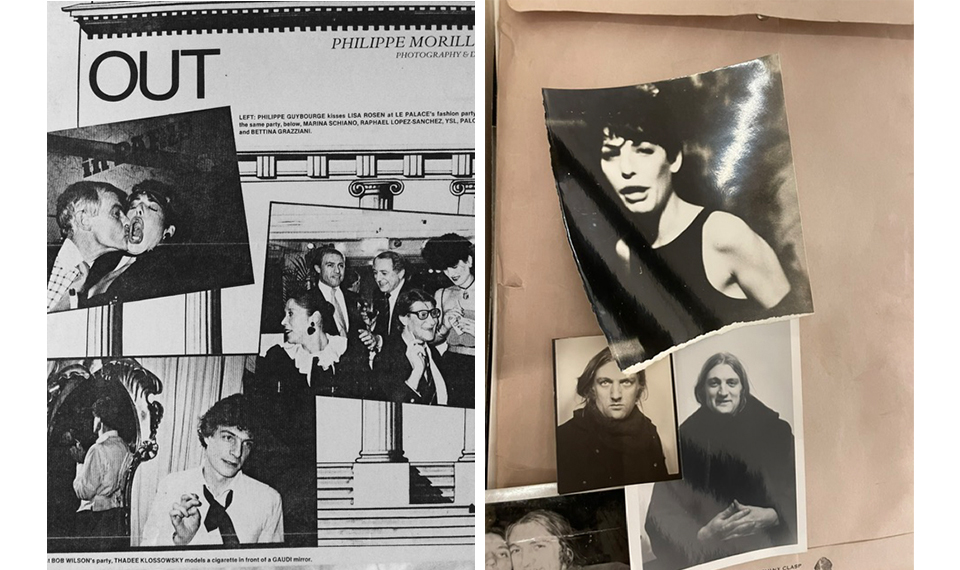
Left: Lisa Rosen is congratulated by Philippe Guibourgé, then of Chanel, in Interview magazine’s “Out in Paris” pages. Photography by Philippe Morillon. Right: Lisa Rosen and Walter Robinson, 1978. Courtesy Lisa Rosen.
SM: What were those Italian years like?
LR: I was there 17 years. My partner, Tony, was a restorer too. We never had any money. We had to advance the money for scaffolding ourselves, and the Italian state can pay you in installments over four years, which means you eat lentils every night. If I see another lentil…
SM: What kept you going?
LR: Just getting to touch those things. You’re on a huge scaffold a foot away from beautiful frescoes. You put your head down, look up, and eight hours have gone by. Lunch and dinner? I forgot.
I worked on ancient Roman mosaics, painted building facades, and for six years I was inside the Colonna family’s palace in the center of Rome. The parents had never allowed anyone in to redo the plumbing or electricity, so when it was finally rewired, they smashed straight through the frescoes to run the wires, a line of holes right across. You look at these palaces and think, “Oh, this is why there are revolutions.”
SM: What did they think of you?
LR: Because I was American, I got away with a lot. They wouldn’t talk business with Tony; they’d talk to me because the American does the business. I didn’t know what the hell I was talking about, but they respected it.
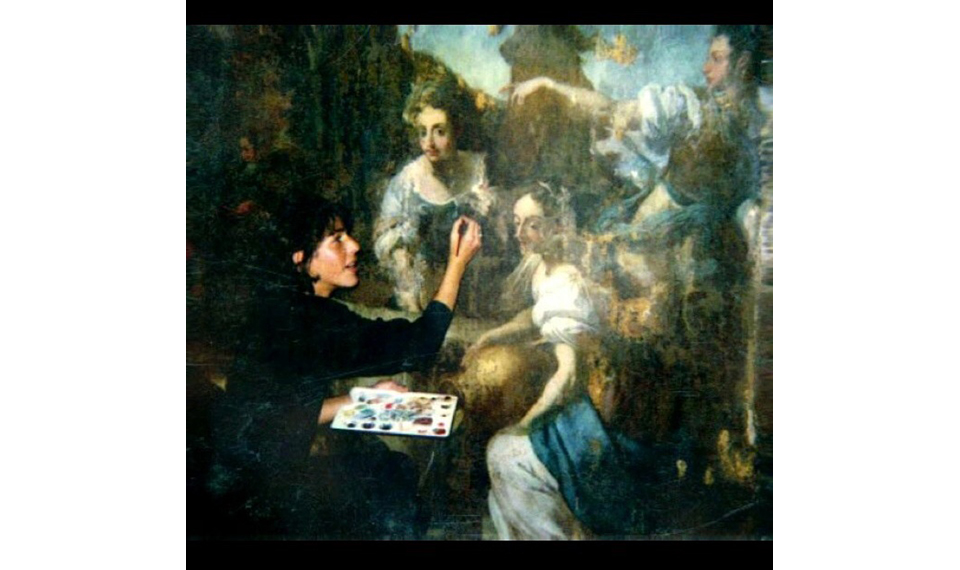
Lisa restoring a painting in Rome, 1986. Courtesy Lisa Rosen.
SM: What’s the most valuable painting you’ve ever worked on? I mean, I know you didn’t work in the Sistine Chapel, but…
LR: No, but I did work in the Vatican. In a corridor called the Cardinals’ Corridor, there were putti all along the edge of the ceiling. When you come through the workers’ entrance to Vatican City, two Swiss Guards in full uniform cross their spears over your head. You know how exciting that is? Every two hours I’d say, “I think I need a coffee,” just to walk under the spears again.
SM: So when you came back to New York, you should have been recognized as a premier art restorer and gotten incredible jobs right away. But it didn’t work that way. You had to work at it.
LR: I had to work at it. It took about three years. I did absolutely everything myself, and that’s why it took so goddamn long to get the ball rolling. I knocked on doors at galleries with my book of what I’d done in Italy. Sometimes it would scare prospective clients because they thought, “Oh my God, she’s worked at the Vatican, she’ll cost a fortune.” So I’d try to play it down. But it was time to come home.
Then I was very lucky. About four years in, I got St. Ignatius Loyola on 84th and Park, Jackie Kennedy’s favorite church, and did everything in the north and south aisles.
SM: But you have to be very good, because it’s costly to do something like that, and you could screw it up. So you have to come with the highest recommendation.
LR: With the Little Church Around the Corner, I was just walking by and went in. It’s pre-Civil War, and it became the actors’ church, because in the 19th century actors were considered so lowly that it was the only church in New York that would bury them. It had 14 Stations of the Cross along the aisles, all blackened by oil heating. You couldn’t read any of them.
I went back the next day and told the bishop, “I’ll clean one for free, to show you what they’re supposed to look like.” It’s like offering someone half a haircut. Once you clean one, you have to clean the rest. I ended up doing all 14, plus the funeral chapel ceiling.
The Chelsea Hotel I did, too. That was the ladies’ powder room, which had been Stanley Bard’s office. The ceiling wasn’t painted directly—it was a beautiful canvas painted by an Italian in the 1890s and placed up there, with putti and flowers. It was filthy, filthy, filthy. So dirty you couldn’t even read it.
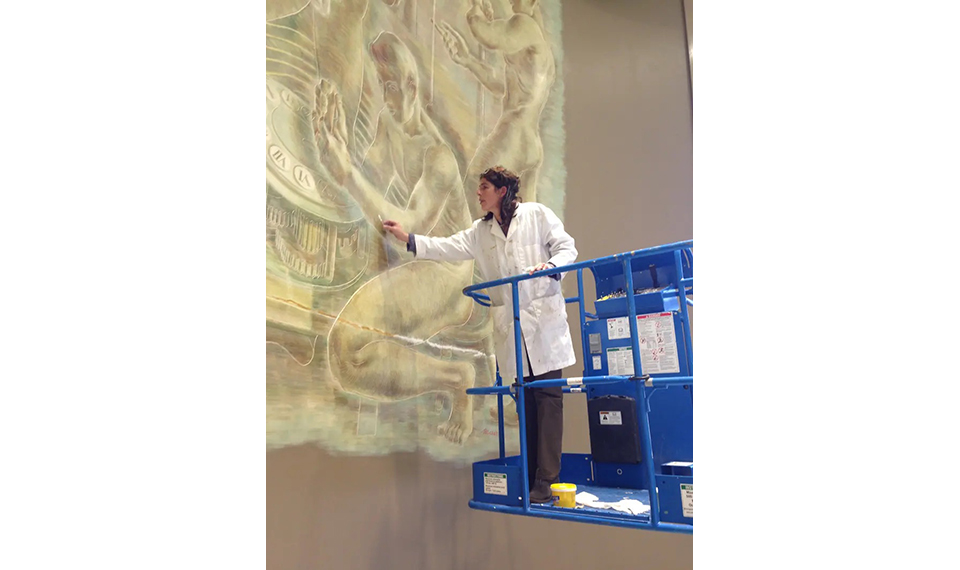
Lisa Rosen at work on entrance mural at Bulova building, Queens, NY, 2011. Courtesy Lisa Rosen.
SM: Do you ever get challenging jobs? Basquiat painted on doors—have you ever had jobs like that?
LR: Glenn owned a Jean-Michel triptych on wood he must have found in the street, in house paint, and the whole thing was lifting. There are ways to get it all down. Then when you fill in what’s missing, you have to use a material that’s different from the artist’s and removable in the future. That’s one of the laws of restoration: the restorer is never the master hand. Put a UV light on a painting and I can see every restoration point immediately. The public just sees a perfect painting.
SM: But how would you prevent a Basquiat painting on a piece of wood he found from continuing to peel?
LR: Well, I could tell you, but then I’d have to kill you. You’ll notice that if you read articles about restoration, they’re not giving you the formula. They’re not telling you what solvent—they’re just saying “a solvent.” You hold it tight to your heart. You work like a bitch to get to this level.
SM: Did you ever have a case where you had to tell a client, “This is not a Rembrandt”?
LR: Oh, Steve, you don’t know how many times. Someone’s grandmother has told them for 50 years that the painting their father brought back from Europe after the war is worth a fortune. It’s their nest egg, their grandchildren’s college tuition. You look carefully, and in the bottom corner there’s a C with a circle around it. It’s a print that maybe has some paint on it. Sometimes you have to tell them gently, or not at all, because they’ll think you’re lying.
This interview has been edited for length and clarity.
WORDS Steve Mass
FEATURE IMAGE Lisa Rosen, 18-year-old Mudd Club “It girl,” and Fab 5 Freddy, 1979. Photograph by and courtesy of Bobby Grossman